

Hotel in Washington DC
Technique: ProCreate Drafting, ProCreate Rendering, Watercolor Rendering
Fall 2025
The program consisted in designing a hotel on Pennsylvania Avenue. The program required several public amenities, like a restaurant, ball room, pre-function space, and meeting areas.
Washington DC, USA


Before designing the hotel itself, we had the option of choosing a lot in the block that is currently the FBI building. Therefore, we had the choice of whether we wanted to design on Pennsylvania Avenue or on E St NW. This would have a great impact on the building's character. I chose the lot on Pennsylvania Avenue to tackle the challenge of designing in such a monumental street.

The lot I chose is found in the intersection between Pennsylvania Avenue and 9th Street NW. In order to create a setback, the building features a chamfered corner with the main entrance. This way, the monumental entrance is seen as one approaches through Pennsylvania. The vehicle entrance would be on 9th Street, in order to avoid stopping on Penn Ave. The first two floors occupy the whole area, while the upper guest rooms only occupy the surrounding wings.


On the ground floor, the main axis goes from the corner entrance and terminates at the restaurant, highlighting it as a main feature. Through this axis, one can then be redirected towards several amenities from the flanking corridors. The vertical core can also be accessed through the central transitory hall. Some amenities on the first floor are open to the public and can be accessed through the street, such as the Salon, Bar, and Cafe.
The ground floor sequence features a series of compression and expansion elements. One first walks through a small foyer that leads into the main lobby. Here, guests find the main reception. One then passes under a bridge visible from the lobby, into a transitory hall. In this hall, one can access the elevators on the left and a grand escalier on the right. Finally, one finds the restaurant, crowned with a stained glass ceiling which features art nouveau and Tiffany glass elements.


The second floor, which can be accessed through the elevators or the grand escalier. The ballroom and pre-function space are found to the right, and meeting rooms populate the left side. One gets a view from the restaurant as one reaches the second floor. An overflow area or private section is present as well. This can be accessed directly through the restaurant.

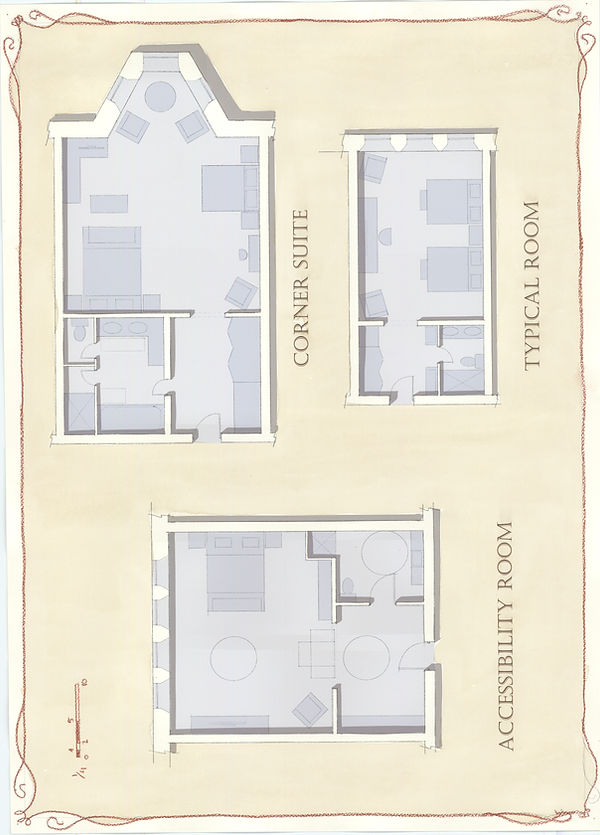
The rest of the guestroom floors have three types of rooms: one ADA room, eight suites, and nineteen typical rooms. The rooms line the interior courtyard or the exterior facade, with a corridor in the middle. This allows maximum light optimization. Most rooms follow a modular system, with the exception of the corner ones. These rooms are larger to mediate the change, and are then used as suites or the ADA room.
Regarding style, the building explores the challenge of acknowledging Washington D.C.'s internationality, while grounding it back to America. For this, the design focuses on the styles of Art Nouveau and Louis Sullivan, respectively. I analyzed several Art Nouveau buildings and hotels in Europe, and Sullivan buildings like the Bayard and Guaranty. From this, Sullivan's tightly detailed elements were implemented instead of rustication. Therefore, these are present on the first two floors. Cornice details were specifically inspired by the Guaranty building and the vertical element separating windows from the Bayard building. The rest of the finishes, like pediments, ironwork details, or any moments that are meant to stand out (like the corner bay), feature Art Nouveau elements, but are always tied to the organicity both styles share.
