

Villa Masterplan & Building
Technique: Watercolor Rendering and Color Pencils
Spring 2025
This project was the main focus of my second semester in Rome. The site is in Frascati, Italy, on the grounds of the former Villa Sciarra a Frascati. Today, this is the site for an existing classical-linguistic high school: Liceo Cicerone di Frascati. The school had been contemplating the construction of a new school with the updated Italian high school building requirements. With this at hand, the project became the design for the new high school. The program consisted in designing the villa masterplan, a close-up botanical plan in the villa garden, and the high school building itself.
Frascati, Italy


Prior to tackling the design phase, we were required to do a comprehensive precedent analysis of an existing villa. I chose Villa Lante a Bagnaia which we had previously visited. I focused on studying the sequential aspect of the garden, the layering and garden progression, water flow, and distinctive elements.

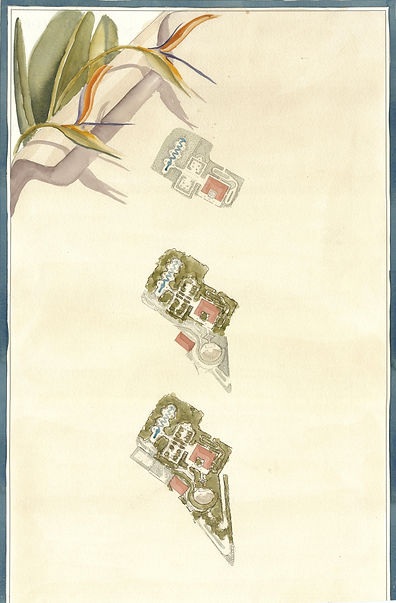
The first part of the design phase was the master plan. It includes the garden progression directly in front of the school site, and the adjacent area in which the villa garden is meant to extend, and where the neighboring elementary school is. The Nuovo Liceo Cicerone has a classical and linguistic focus. Therefore, the garden design is inspired by The Three Theban Plays by Sophocles, honoring the school’s classical focus. The narrative of the plays unfolds through the garden design, with ornamental and botanical motifs.


The garden progression directly in front of the school is divided into three segments, representing the Three Theban Plays. The grotto from the original villa is preserved, as can be seen in the longitudinal section. It has a few sunken steps, featuring a statue of Sophocles. From here, the narrative begins.
The first section is the Italian formal garden. It depicts Antigone, the first of the three plays written by Sophocles. Each part of the garden represents a theme of the play, carefully considering the choice of colors and plants. In the continuation of the narration, one gets to Oedipus Rex, or in villa terms, the bosco area. In this, several of the existing trees are preserved. Through this ‘forest’, one finds winding paths to grow through, representing the chaos and confusion Oedipus faces in this play. Finally, the paths lead to Colonus, where we get to the last play Oedipus at Colonus. The trees clear up and one gets an unmatched view of Rome. Finally, enlightenment. Several motifs recall the play, like the city gates of Colonus, the pools resemble Oedipus’ new-found tranquility, and the central magnolia tree shows how beauty comes from continuous change.



This is a botanical plan of the Italian formal garden featuring Antigone. The four sections of the garden represent four themes present in the play:

Next to the main garden area. One finds the elementary school on the lower level. The gym and the theater are between the elementary and the high school, as they are shared features. Both complexes, the high school and the elementary, are closed off, and the garden is public. This way, the students and the whole community can make use of the amenities in the garden, while having the education areas strictly private.


The high school itself features two side wings, with a slightly taller center, and an altana to finish it off as an asymmetrical elevation. The main precedent was Villa Falconieri, featuring a terrace on the uppermost floor. The classrooms are found on the side wings, making the center area for communal use, such as offices and the library. The stairway that is topped by the altana contains the access to the library, as well as another smaller terrace and the altana itself. Past the center component, the two wings hug a courtyard delineated by a portico. This provides shade for the students' walking area, serving as a secondary space between the interior and the courtyard itself.